Why Is Parent Training Important for Children With Autism?
When a child begins ABA therapy, parents often wonder what their role should be. Is the therapist responsible for teaching the skills, while parents simply watch the progress?
At Everything On The Spectrum (EOTS), we believe the answer is very different. Parent training is an essential part of effective ABA therapy because children need opportunities to use their skills beyond the therapy setting. Our approach is built around radical collaboration—wrapping around the child and family so that progress can carry into everyday life.
For families navigating an autism diagnosis, this can be empowering. Instead of feeling like you're on the outside looking in, parent training gives you practical tools and a stronger understanding of how to support your child at home.
What Is Parent Training in ABA Therapy?
Parent training is the process of helping caregivers understand and use strategies that support their child's individualized ABA goals.
Rather than expecting parents to become therapists, the purpose is to give families practical skills they can use during ordinary moments—mealtimes, play, transitions, communication, routines, and daily living activities.
At EOTS, caregiver training is a required component of therapy because skills need to translate into the home environment for progress to have meaningful real-world value.
Why Is Parent Training Important for Children With Autism?
1. It Helps Skills Generalize Beyond Therapy
A child might successfully learn a skill during an ABA session. But what happens when the therapist leaves?
The ultimate goal is for that skill to become useful in everyday life.
Parent training gives caregivers opportunities to reinforce skills during naturally occurring situations. This can help children practice communication, social interaction, adaptive skills, and behavior strategies across different environments.
At EOTS, we are transparent about this: if skills aren't translating outside the clinic, we haven't finished our job.
2. Parents Become Confident Partners
Receiving an autism diagnosis can feel daunting and isolating. Parents may have questions about what to do, how to respond to challenging behaviors, or how to encourage new skills without creating additional stress.
Parent training helps replace some of that uncertainty with practical knowledge.
Families can learn how to:
- Support communication
- Encourage independence
- Respond consistently to behaviors
- Practice skills during daily routines
- Create opportunities for learning through play
- Reinforce progress at home
The goal is not perfection. It is helping parents feel connected, informed, and supported.
3. It Supports Independence
Independence is the backbone of the EOTS approach. The brand's guiding philosophy is that what matters is not simply what adults do for children, but what children are taught to do for themselves.
Parent training supports this philosophy directly.
Instead of automatically stepping in when a child struggles, caregivers can learn how to provide the right level of support and gradually encourage the child to participate more independently.
This might involve teaching a child to:
- Request assistance
- Complete parts of a morning routine
- Clean up after an activity
- Communicate choices
- Participate in household routines
These small stepping stone goals can become part of a much bigger journey toward independence.
Parent Training Helps Families Understand the "Why"
Behavior Is Communication
When a child engages in challenging behavior, it can be tempting to focus only on stopping what is happening.
EOTS takes a different approach.
The team uses data to understand the why behind behavior while remembering that there is a child behind the data.
Parent training can help caregivers recognize what may be happening before, during, and after a behavior and learn proactive and reactive strategies that support the child's needs.
This creates a safer, judgment-free approach where the goal is not to label a child as "bad" or "difficult," but to understand what they are communicating and teach more effective skills.
Parent Training Creates Consistency
Children often move between several environments every day:
- Home
- School
- Therapy
- Community settings
When caregivers and professionals use consistent approaches, children have more opportunities to understand and practice the same skills.
This is why EOTS describes its approach as a wrap-around model. Success is a team effort involving the child, caregivers, therapists, and other important people in the child's life.
What Might Parent Training Include?
The specific content should always be individualized to the child and family's needs. EOTS rejects one-size-fits-all ABA and instead develops customized treatment plans around family priorities and the child's needs.
Parent training may involve learning strategies related to:
Communication
Caregivers can learn ways to create opportunities for their child to communicate wants, needs, choices, and emotions.
For children who use AAC, communication support can be especially important. EOTS emphasizes AAC as an evidence-based facilitator of communication rather than something that prevents speech development.
Daily Living Skills
Parents can practice strategies for encouraging greater participation in everyday routines such as dressing, eating, hygiene, and cleanup.
Transitions
Caregivers can learn ways to help children navigate changes between activities and routines more successfully.
Social Skills
Everyday family interactions provide natural opportunities to practice turn-taking, engagement, requesting, and connection.
How Parent Training Can Fit Into Everyday Life
Parent training does not have to mean creating another complicated schedule for an already busy family.
Some of the best learning opportunities happen naturally.
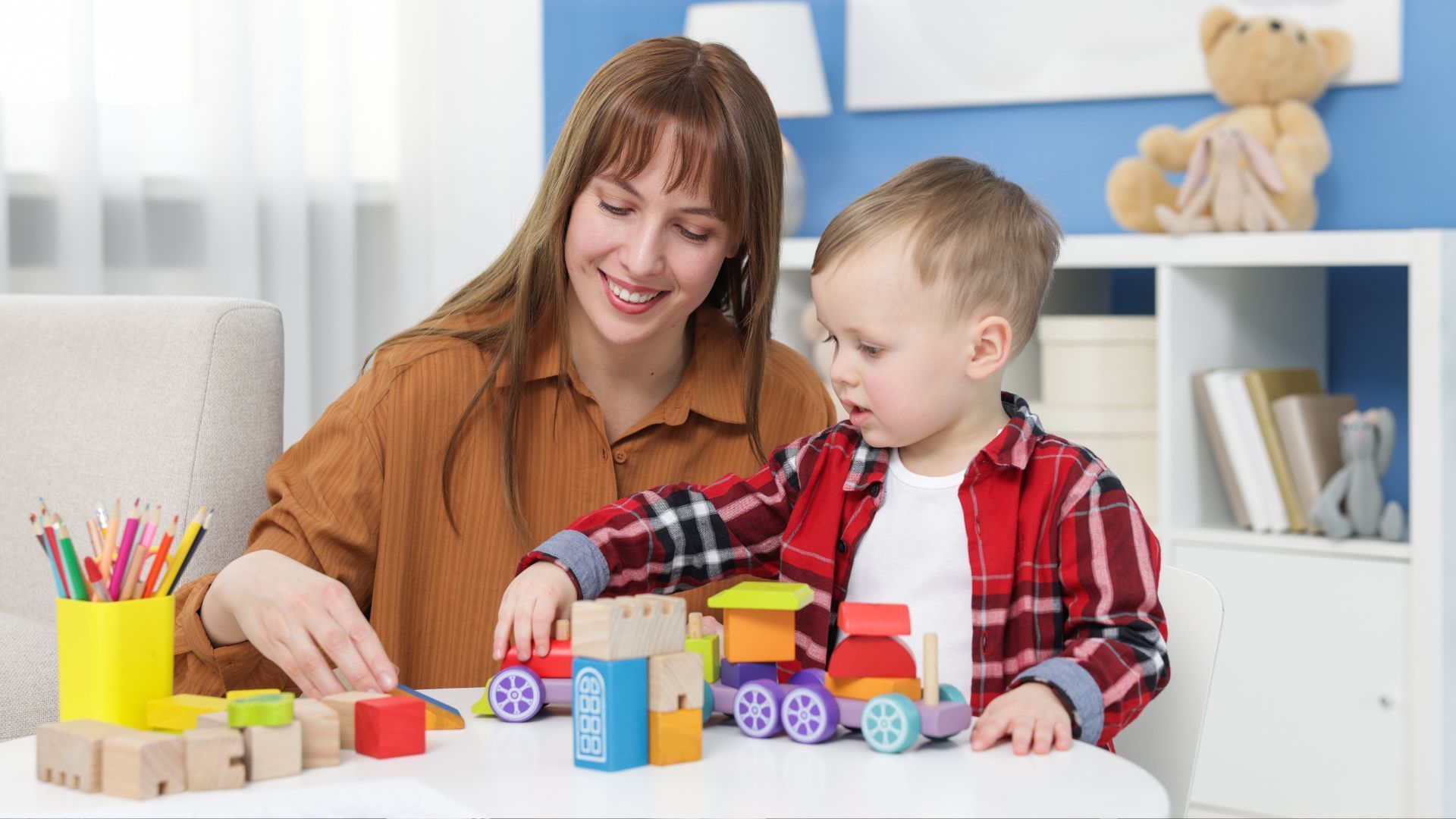
For example, during breakfast, a caregiver might create an opportunity for the child to request a preferred food. During cleanup, the child might practice following a simple instruction. During play, the family can practice turn-taking or communication.
These moments turn ordinary routines into meaningful opportunities for skill development.
And because EOTS believes clinical work should not be sterile, play and rapport remain important parts of the learning process.

What Should Parents Expect From a Good ABA Provider?
A strong parent-training program should leave families feeling supported rather than judged.
Parents should be able to ask questions, share concerns, and understand why particular strategies are being recommended.
Look for an ABA provider that:
- Includes caregivers as active partners
- Explains strategies clearly
- Uses evidence-based practices
- Individualizes goals
- Communicates openly
- Measures progress
- Focuses on real-world skills
- Keeps independence at the center of treatment
EOTS describes this as clinical warmth—combining clinical rigor with genuine human connection.
Frequently Asked Questions
Is parent training required in ABA therapy?
At Everything On The Spectrum, caregiver training is a required component of therapy because the goal is to help skills translate into the home and everyday environment.
Does parent training mean parents become ABA therapists?
No. Parent training is about giving caregivers practical strategies and confidence to support their child's individualized goals in everyday situations.
How does parent training help with independence?
It teaches caregivers how to create opportunities for children to participate in routines and gradually do more for themselves rather than having adults automatically complete tasks for them.
Can parent training help with challenging behaviors?
Yes. Training can help caregivers better understand the factors surrounding behavior and use proactive and reactive strategies tailored to the child's needs.
Why is consistency important?
Children need opportunities to practice skills across environments. Consistency between therapy and home can help skills become more functional and meaningful in everyday life.
Conclusion
So, why is parent training important for children with autism? Because therapy should not stop when the session ends.
The most meaningful progress happens when children can use what they learn in the places that matter most—at home, at school, during play, and throughout their community.
At Everything On The Spectrum, parent training is part of our commitment to radical collaboration and whole-child care. We work alongside families to create small stepping stone goals that move children toward the bigger picture: greater confidence, meaningful connection, and lasting independence.
There is a child behind all of the data. And there is a family behind every treatment plan.
You Don't Have to Navigate This Alone
If you're looking for an ABA provider that sees your family as a partner—not just a participant—Everything On The Spectrum is here to walk alongside you.
Contact us today to learn more about our individualized ABA services and caregiver training approach, and discover how we can help your child build meaningful skills for greater independence at home, at school, and beyond.